• About this humble little website

Football: Wherever it may be

~ Laurence's football travels

Football: Wherever it may be

Author Archives: laurencereade

All Things Being Equal

24 Sunday Feb 2013

Posted by laurencereade in O

≈ Leave a comment

Tags

Alfir Potter, chris wilder, Deane Samiily, Josh Parker#], League 2, oxford united., sean rigg, soccer, Tom Craddock, York City

Saturday 23rd February 2012 ko 15.00

League 2

OXFORD UNITED 0

YORK CITY 0

Att 5,808 (319 away)

Entry S/T

Programme £3 (inc Oxford Mail)

I’ve been in colder grounds, and I’ve seen worse games of football, but this encounter was definately the worst combination of the two I’ve seen in many a long year. The club designated the game as “Military Day” so real heroes were much to the fore, with Chelsea Pensioners, and the Royal British Legion providing a guard of honour for the two teams. It really should have been the other way round.

It was plain embarrassing to watch the officials rope in substitute keeper Max Crocombe to first measure one goal, then once it had been proven it wasn’t level to help the groundstaff to level to offending frame. Having Rugby at the ground does mean the goals do get removed regularly, but to not check something as basic as this is indefensible.

It came as no surprise that Chris Wilder selected an unchanged team from the eleven that provided a welcome, away win at Plymouth. It’s fair to say that whilst the United’s defence had precious little to do, the attack, save for Josh Parker looked as unlikely as ever to trouble the scoresheet. Passes were miss-placed, shots disappeared into the ether, and there was a distinct lack of ideas of how to change things to beat a frankly poor York side, that were more than happy with a point.

Alfie Potter replaced the anonymous Tom Craddock, and Deane Smalley was brought on to play out of place on the wing to replace a specialist in that position, Sean Rigg. Oxford puffed, York prevaricated, and the crowd shivvered, frustrated in the cold. Chris Wilder glumly looked on, hands in pockets, shoulders hunched against the cold and the brickbats.

It really was a nothing game in a nothing season. They’ll be no playoffs, or looking the other way, relegation. Just a series of underwhelming games to see out the season, before there’ll undoubtedly be a mass cull of the personnel. The only question is who, and does it involve the non-playing staff too? Given the lack of information eminating from the club, your guess is as good as mine.


The Sons of Light

22 Friday Feb 2013

Posted by laurencereade in D

≈ 3 Comments

Tags

Arnold Tawonezui, Combined Counties League, Dorking, isthmian league, Meadowbank, Molesey, Moses Spencer, Ralph Vaughan Williams, Reece Jackson, Thomas Cubitt, Tommy Harper

Thursday 21st February 2013 ko 19.45

Combined Counties League Premier Division

DORKING 3 (Harper 10 70 Jackson 23)

MOLESEY 2 (Tawonezui 51 Spencer 65)

Att c50

Entry £6

Programme £1

There are so many similarities between Dorking’s Meadowbank and Wakefield’s Belle Vue, the traditional football grounds both set in the centre of town. From then on, the similarities cease, this is the land of composer Ralph Vaughan Williams, actor Laurence Olivier, and the builder of much of Belgravia, Thomas Cubitt.

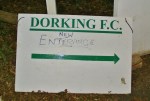
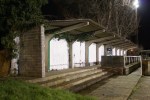
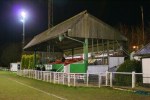
There’s nothing remotely Cubitt-inspired about Dorking’s football ground. The influences here are the needs of the Isthmian League, one notch higher up the pecking order than the club’s present status, the club leaving the Isthmian League when that competition disbanded their Division Two at the end of the 2005/6 season. What’s left is a gorgeous 200 seat stand dating from the ground’s opening in 1956, and shallow terracing on most of the other sides. On the far side there’s the asbestos and concrete covered enclosure seen at so many Isthmian League grounds. It’s slowly being grasped by the ivy, but the club badge can still be seen, the famous Dorking chicken, popular on Victorian dining tables, and identifiable from the breed having five claws rather than the normal four.

I strolled into the clubhouse to read my programme and found the club stalwarts setting up a portable television to watch the closing stages of Tottenham Hotspur’s Europa League game. I ruefully spotted the frame where the projector-style set once stood. Still the welcome was effusive, and for once the game lived up to the surroundings, even of there was a caveat of sorts!

When copying down the line-ups outside the referee’s room I’d managed to hear the Dorking manager’s team talk; it does help when someone has punched a hole in the door! Two words were used a lot. One I can’t repeat here, but I’m sure you can guess; the other was naivety. There was no trace of that though straight after kick off, as Dorking raced into a two goal lead and it wasn’t for some appalling finishing it could have been double that at half time.

Molesey looked a far better team in the second half, but what happened next….well imagine you are the referee, what would you do? The Dorking defence didn’t clear the ball properly and so Arnold Tawonezui attempted to lob the keeper, Kieran Campbell. Campbell could only push the ball up and back, so the ball slowly dropped down into the……and that’s when the floodlights failed!The goal was given, although the Dorking management undoubtedly had a point when they wondered how the officials managed to see the ball cross the line!

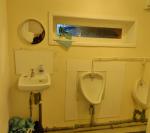
It became obvious that this wasn’t a simple case of floodlight failure as the darkness extended to many of the surrounding streets. Nevertheless, the lights had to be allowed to cool down before re-lighting but during the 15 minute wait I discovered a wonderful piece of football ground design. Yes, the gents is designed so you needn’t miss the action, complete with paper towels to wipe away the condensation!

After the re-start Molesey carried on what they’d started, centre half Moses Spencer half heading, half bundling home from a corner, to give parity that looked barely plausible just before half time. Dorking’s naivety suddenly was lost, and they won the game with a twenty-yard screamer from Tommy Harper that seemed out-of-place with the charming errors it followed.

I travelled home, dropping off a fellow hopper on the way, and why on earth I’d waited so long to pay them a visit. It really is a gem.


Merrie City

20 Wednesday Feb 2013

Posted by laurencereade in W

≈ 1 Comment

Tags

Belle Vue, College Grove, Dimple Wells, Fc, holy trinity church, Northern Premier League, Richard Tracey, soccer, Tom Marsden, Trinity, Wakefield, west yorkshire city, Wildcats

Tuesday 19th February 2013 ko 19.45

Northern Premier League-Division One North

WAKEFIELD 1 (Marsden 75) Grant missed penalty 10

OSSETT ALBION 1 (Tracey 28)

Att 92

Entry £8

Programme £1

Joni Mitchell once sang “You don’t know what you’ve got ’til it’s gone,” and I feel that way about the urban football ground. As a small boy visiting Oxford United’s Manor Ground, you felt the anticipation as you walked through the narrow back streets to the turnstiles, often at the end of a cul-de-sac. The rusting turnstile, with the brass plate from a manufacturer from a northern town, and the brickwork painted over time and time again so only a rough pattern remained. A floodlight at each corner, and a stand with a pitched roof completed the painting.

Time, tide and the Taylor Report have seen a general drift of the larger grounds to out-of-town locations, and many of the classic football grounds have disappeared. The same process is happening with Rugby League grounds, but so far Wakefield Trinity Wildcats’ Belle Vue ground is still there to be enjoyed. It’s all there, the town centre location, and the narrow side streets, even the oft-painted brickwork!

Wakefield Trinity were formed from men who worshipped at The Holy Trinity Church in the West Yorkshire city in 1873. When the schism between the northern professional (League) clubs and the amateur (Union) south happened in 1895 Wakefield as a city found itself with both an amateur Union club, and a professional club,Trinity. It meant that the club needed its own ground, and Belle Vue was purchased in that year. The club had in fact played there since 1879, and when I entered the stadium via the one open turnstile in the corner I stopped, stood, and sucked in the atmosphere.

This is the football club’s second stint at the ground. Emley FC moved here in 2000 and re-named themselves Wakefield & Emley. When a new club was started back in Emley the suffix was dropped, and around the same time the club moved to the former Wakefield Rugby Union ground, College Grove. The club was evicted in 2011, and spent a season sharing at Ossett Town, before returning to Belle Vue for this season.

Three sides of Belle Vue are the quintessential large football/rugby ground, with the fourth a staple of the rugby ground of both codes, the multi-storey hospitality block. With just 92 present, all sides were accessible, including the bar area in hospitality, assuming you were prepared to pay the high prices for food and drink demanded at professional sport, I was not.

I contented myself with getting a teamsheet, ” No problem mate, I’ll print you one off,” (contrast that with Maidstone!) and walking round and enjoying a generous slice of sporting history.  Enjoy it while you can, as Belle Vue doesn’t satisfy future Superleague ground criteria, so Trinity are looking to either move or redevelop.

Behind the goal on the huge terrace a small crowd of young boys shouted their support for Ossett in a game that didn’t quite live up its exhalted surroundings. Two struggling sides took just the one pass too many to create enough impact to force the win. Josh Grant missed an early penalty for Wakefield, and Albion took control of the game, scoring through former Sheffield United forward Richard Tracey. They’ll wonder how they failed to force the win as a defensive howler allowed Tom Marsden to nip in to slide home.

It was one of those draws that seemed to be of little use to either club. Thatr’s a real shame as both club’s have been notably friendly when I visted previously, Ossett Albion at Dimple Wells, and Wakefield at their former home of College Grove. I’ll look forward to seeing them again. Hopefully Belle Vue won’t be paved in favour of a parking lot in the meantime.


In Another World

18 Monday Feb 2013

Posted by laurencereade in C

≈ 8 Comments

Tags

Arlo Reddick, Cerne Abbas Giant, Charles Kingsley, Clovelly, Higher Clovelly, Ian Chan, Lundy, North Devon League, Roib Kearney, Thomas Frost, Torrington FC

Saturday 16th February 2013

Clovelly

Entry, Parking and 2 Museums £6.50

Then at 14.30

North Devon League Intermediate Division 1A

CLOVELLY AFC 4 (Kearney 8 18 77 88)

TORRINGTON RESERVES 2 (Frost 7p Reddick 64)

At Clovelly Parish and War Memorial Hall, Higher Clovelly

Free Entry

Nothing for Sale

With a bed for the night in Dorset it seemed logical to look for something interesting to see in the South-West, as well as a football match afterwards. I ended up settling on Clovelly because I hadn’t been there since childhood, and I fancied a low-level game; sometimes you need to re-connect with the grass-roots and get muddy feet!

During the 100 mile 2 hour journey, I questioned my decision regularly. I stopped at the Cerne Abbas Giant, partially as part of yesterday’s “Prehistoric” tour, and as a final attempt to find something “Unworldly” in Hardy’s Wessex. Once again I was foiled, the thick fog making the chalk carving in the hill invisible.

I crossed in to Somerset, then into Devon, and gradually became aware of the Holiday Parks and Theme Parks, that have become the tourist industry’s way of coping a climate that whilst temperate, can’t compete with the Spanish Costas. In turn that scene changes once you turn right off the Barnstaple Road, and head downhill to Clovelly.

Roughly 1,600 people live in this pretty fishing village, famous for its cobbled streets, and steep gradient down to the sea. Due to this, and the narrowness of the streets, motor transport is banned by the Hon. John Rous, a descendant of the Hamlyn family who have owned Clovelly since 1738. That is where there’s some controversy, as its highly unusual to be charged simply to visit a viable village where people live and work normally.

Certainly the visitor centre is dreadful, simply a tourist catch-penny, I scuttled through quickly, but the village whilst beautiful, has more to it than meets the eye. With access restricted, if you live here you have to find a way of getting anything heavier than a bag of shopping down to your house. The solution is  two bread baskets tied together with wooden runners to form a sled. I spent some time trying to take pictures avoiding them, until I worked out what they were. Another surprise was the sheer number of cats! Yes, there is no lack of fish, and our feline friends would have no issue with the slope, but everywhere I looked there was a cat in need of a cuddle!

One of the two museums your entry fee gives access to (the other is a fisherman’s cottage) is the home where Charles Kingsley grew up. He was a social reformer, and a supporter of Charles Darwin’s Theory of Evolution. His book The Water Babies is influenced by Clovelly, and Westward Ho! by the North Devon peninsula.

For all of that I clambered back up the hill, pausing to watch a lady tending to a garden with a 1:3 gradient, still pondering what it would be like living in a village that’s part tourist attraction, part working environment.

With the inevitable boxes of fudge for my family stowed in the back of the car I drove the mile or so up the hill to Higher Clovelly. This is a far more typically Devonian village without the yoke of restrictions imposed on its sister down the hill. As is so often the case, the football club plays on a pitch by the village hall, but in this case there are two factors to consider. Firstly its quite a village hall, with billiard room, kitchen, bar and mini-theatre. In fact, the referee changes in the stage area, with the curtains drawn! However it’s view from the little stand that is the ground’s selling point.

You can see the Puffin sanctuary island of Lundy isolated in the Bristol Channel. These days it only has a population of 28, with plenty more visiting on day-trips to view the wildlife and to visit the Bronze Age Burial Mounds, and Mesolithic flint work. With a full hour before kick off, and the ground deserted, I stood and watched a boat sail across the channel between the island and the mainland, and took a deep breath. Here was my unworldly moment, in the place I’d expected it least!

It got better as the players and officials arrived. To a man and woman, all were friendly and both teams put on an entertaining game on a heavy, bobbling pitch that seemed to have been cut for rugby rather than football. The undoubted star of the show was Clovelly player-manager Robin Kearney whose clever late runs were incomprehensible to the Torrington defence. He scored all 4 of Clovelly’s goals, ably assisted by captain Ian Chan’s long throws. Torrington tried hard, and will feel that 2 goals is scant reward for good play, taking account of the level (10 promotions from the Football League) and the playing conditions.

I smiled as I watched the last five minutes as a couple of hours before I wondered whether paying £6.50 to visit Clovelly was good value for money. I’d realised that when you take Clovelly AFC into account too, it’s a real bargain.


Pre-dating Hardy

17 Sunday Feb 2013

Posted by laurencereade in H, M, S

≈ Leave a comment

Tags

Ben Osborne, Christchurch, County Ground, Dorchester, Dorset, Durnovaria, Hamworthy United, Harry Cornick, Jeffreys, Joseph Shovelton, League, Maiden Castle, Mary Channing, Maumbury Rings, Monmouth Rebellion, Poundbury, Preseli Hills, Russell Cook, Stonehenge, Tess of the d'Urbervilles, The Bloody Assizes, The Mock Wife, Thomas Hardy, Wessex

Friday 15th February 2013

Stonehenge, near Amesbury, Wilts

Entry £7.80

Maiden Castle, near Dorchester, Dorset

Free Entry

Maumbury Rings, Dorchester, Dorset

Free Entry

then, at 19.45

Wessex League Premier Division

HAMWORTHY UNITED 2 (Shovelton 26 43)

CHRISTCHURCH 3 (Cook 60 Osborne 65p Cornick 82)

Att 94

Entry & Programme £6

The roots of this lie in Hamworthy’s tenancy of the Dorset County Ground, just outside of Poole. An under-18 County Cup tie was scheduled for the Saturday, so with their fixture being a local derby, it was shunted backwards, affording me a finale to a day’s sightseeing! My friend Mike offered me a bed for the night nearby, so with a full tank of diesel, £50 in my pocket, and a headful of ideas, I had all the ingredients for a road trip!

With the counties of Wiltshire, Hampshire and Dorset being covered, there was no doubt I was going to be exploring Thomas Hardy country, but having visiting many of his haunts previously, I fancied something different, and dare I say, unworldly?

I don’t want to think too much how many times I’ve passed the monoliths of Stonehenge on the A303. I do wonder how many times cars have crashed, their drivers distracted by the prehistoric feat of engineering to the side of the road. Once you adhere yourself to the audio guide, you’re given still more reasons to stand and stare. The henge we see today was built 2500-1600 BC, but wooden henges existed prior to that, and the site started as an earth and ditch structure as early as 5000 BC.

The stones aren’t local, they’re bluestones up to 45 tonnes in weight transported from the Preseli Hills in South-West Wales. Let’s consider that for a moment, that’s 180 miles, with nothing more than wooden rollers, and brute human strength to transport the stones, then place them in exactly the right place to catch the sun at the solstice.

But why? The archeologists don’t think it was Druids, surprisingly. I’ve long since worked out that the best buildings tend to be religious, the glorification of a god seems to bring both the best and worst of people, but Stonehenge seems to have fulfilled a military need too. Again that’s not unusual, churches have towers so as to provide a place for a look-out and to defend the area if under attack, but the more you study, the more of a mystery the place seems to be! I do recommend the guide-book here, an absolute bargain at £5. The only quibble I can muster about the place is I could find absolutely nothing unworldly about Stonehenge. Maybe if I arrived at the solstice when the druids are chanting I would, but spirituality aside, it’s a fascinating place. Hardy clearly felt something spiritual here, as he used Stonehenge in Tess of the d’Urbervilles for the Tess’ final day of freedom, lying on the Alter Stone, with all the controversial (of the day) connotations that would produce.

From there it was an hour’s drive to Dorchester, or Casterbridge if you’re a Hardy aficionado (The Mayor of Casterbridge). I eschewed the delights of Hardy’s House, Max Gate, mainly because only a room or two is ever open, and opted for Maiden Castle, to the south of the town. It’s an Iron Age hill fort, dated around 600BC, and be warned it’s quite a hike to climb to the top, but worth the effort! It was expanded, tripling in size around 450BC making it by some definitions the largest in Europe. The views over Dorchester and the suburb of Poundbury, designed by Prince Charles are spectacular.

My last site was the smallest, but had the most varied history. The Maumbury Rings, started life as a henge, a smaller version of what I’d seen earlier. Their location, near the centre of Dorchester has meant they’ve changed use frequently over the centuries. In Roman times they were converted to an amphitheatre for the people of Durnovaria (Dorchester), before being converted once again to a fort during the English Civil War (1642-1649).

In 1685 after the Monmouth Rebellion the Rings were converted back to an amphitheatre. This time the “Entertainment” was public executions, as The Bloody Assizes saw Judge Jeffreys sentence 80 of the rebels to be executed here. Soon afterwards, in 1705 saw the odd case of Mary Channing, which Hardy based his poem The Mock Wife on.

Mary came from a well-to-do family in Dorchester, and received an education commensurate with her status. The problem was she took a liking to the male population of the town, several of them! Her despairing parents decided the best solution was to marry her off quickly so as to avoid a scandal, so Thomas Channing from nearby Maiden Newton was found, and despite neither party being at all keen they were married.

It’s fair to say the marriage wasn’t a success. With in 4 months of the nuptials, Mary bought a vial of Mercury and poisoned Thomas, him living just long enough to disinherit her. She was quickly caught, tried, and sentenced to death, the execution delayed due to her successfully pleading her belly, and the wait for her child to be born. Eventually her son arrived and soon after she was strangled then burned at the Rings.

Writing this I’m struck at the similarities between the Channing case, and that of Mary Blandy in Henley-on-Thames.

https://laurencereade.wordpress.com/2012/12/28/memories-of-henley/

Perhaps every town has a Mary Channing or a Mary Blandy whose ghost haunts its past?

I drove east to the outskirts of Poole for the evening’s game, and the whole ambiance changed, from the historical to the modern. From the harbour, with the Sunseeker powerboats propped up for sale in dry dock, to the modern harbour bridge with its blue Krypton lights showing you the way.

The County Ground is a fine home for Hamworthy, and could easily stage games at a higher level. There’s generous cover behind one goal, but the undoubted star of the stadium is the main stand. It’s beautifully maintained, and painted in club colours. It was a pleasure to watch a game with that as a backdrop.

And what a game it was! Christchurch came into the game with a defensive injury crisis and it showed as Hamworthy raced into a 2 goal lead at the break with Joseph Shovelton applying the coup de grace on both occasions. But if you can’t defend then you may as well attack, and Christchurch did exactly that in the second half.

AFC Bournemouth have just signed teenage winger Harry Cornick, but loaned him back to Christchurch for the rest of the season, and he tormented the defence. His cross found Russell Cook for the first and he was fouled for Ben Osborne’s penalty. His reward was a goal, showing composure to slide the ball home from an angle.

It was an entertaining coda to a busy day, even if I’d found nothing that was remotely unworldly today. With a busy itinery for Saturday though, there was still opportunity.


Out Through The In Door

13 Wednesday Feb 2013

Posted by laurencereade in O

≈ 1 Comment

Tags

chris wilder, Damian Batt, Fleetwood Town, James Constable, Junior Brown, Liam Davis, Matt Crowther, oxford united.

Tuesday 12th February 2013 ko 19.45

League 2

OXFORD UNITED 1 (Davis 89)

FLEETWOOD TOWN 2 (Crowther 28 Brown 55)

Att 5,003 (76 away)

Entry S/T

Programme £3 (reissue from postponed game with insert that cost £1 if sold separately)

A few years ago I watched a man get fired. It wasn’t the brief, loud, slanging match, with the loser being shown the door, that you see in tv dramas, it was a slow painful process. The man concerned was gradually demoralised, and when he realised that there wasn’t a suitable job for him to resign and slip into, he grimly held on, until one Monday he wasn’t there. The whispers amongst the staff over the next few days confirmed the awful truth.

Since then I’ve learned the signals, the isolation of the dismissee, with the head bowed, the body language, and the repetition of the mistakes that got him into that position in the first place. I saw many of those signs in Oxford United manager Chris Wilder last night. A man lost in his own thoughts, alone yet surrounded by his management team and just over 5,000 supporters.

The groundstaff managed to produce a new line in appalling pitches, this one had trenches made by tractor tyres pulling the spikes to aerate the grass/mud. With Justin Richards out for the season (was he given a medical?), Deane Smalley accompanied James Constable up front, without there ever being a jot of understanding between the two. United had enough possession, but on the odd occasion it produced a chance it was wasted. Alfie Potter’s choice to pass when it looked simpler to shoot, spoke volumes for both his, and the team’s lack of confidence.

You knew it was going to end in tears. Fleetwood moved the ball neatly, but hardly devastatingly from right to left, and there was Matt Crowther in a Damian Batt shaped hole to slot past the Oxford United keeper. On the subject of the keeper, Max Crocombe spent the end of the first half warming up, and the player brought in his place played the second half with his left thigh heavily strapped up. If that’s his hamstring, then I suspect Crocombe will get the nod on Saturday.

With few options on the bench and still fewer ideas on the pitch, the second half carried on in much the same vein as the first. Even Fleetwood’s second goal bore similarities to the first, a high ball was nodded back across the 6 yard box, and the defence stood a watched at Junior Brown stooped to nod home.

James Constable hit the post then watched as Sean Rigg blazed the rebound into the stand, and Damian Batt watched his strike well saved by Scott Davies. Eventually United did score, Liam Davis’ fine 25 yard pile-driver, which was out of character from the dross that had preceded it. And here’s the rub, Fleetwood were no more talented than Oxford. Better organised, fitter, and definitely more aggressive, all traits that United should be showing. Either they want to make the playoffs, or there’s a relegation battle looming. There are no half measures in League 2 this season.

I left pondering how long you can leave someone in a position this hopeless, when it would clearly be kinder to take the burden away. With as many as 14 players’ contracts up in July it’s now the time to look at what should be retained, and what should go. Its become clear, sadly the man to do that isn’t Chris Wilder.


The Commitments

11 Monday Feb 2013

Posted by laurencereade in O

≈ Leave a comment

Tags

3G, Catherine Beaver, Community Arena, Hannah Cox, ladies, Natasha Caswell, Newquay, Oxford City, oxford united., soccer, South West Womens Combination, Victoria Taylor

Sunday 10th February 2013 ko 14.00

South-West Women’s Combination

OXFORD UNITED 2 (Beaver 26secs Caswell 53)

NEWQUAY 1 (Taylor 23)

Att 10 (h/c)

Entry FREE

Programme None

Normally speaking Oxford United’s women’s team play their fixtures at the former Rover Cowley Ground, on Romanway, but with the pitch waterlogged the tie was switched to to Oxford City’s new 3G pitch at Court Place Farm.

The Community Arena incorporates a pavilion and 6 netball courts together with the full-sized, caged 3G pitch. It opened in January 2012 at a cost of £2.1 million, but there are two flaws if you’re a spectator, there is no cover, and you have to watch from the outside of the cage. The latter isn’t too bad, I’m old enough to remember fences at football grounds, but it’s difficult to track the ball from left to right as the fence gets more dense. That I won’t remember, what I will, was the freezing cold, and the driving rain that slowly turned into sleet.

Oxford are top of the division, 4 points ahead of Keynsham Town, who have 2 games in hand. That is because Oxford have had a run in the Women’s FA Cup, in fact they play Premier League Newcastle United at Grenoble Road on Sunday 24th, their first appearance at the main stadium. With the Cornish Peppermints down in eighth place I expected a straightforward home win, even if, sensibly the visitors had stayed in Oxford the night before. That would be in marked contrast to their male counterparts!

It started so well,  Lauren Allison outpacing her marker; her shot was saved but Catherine Beaver was sharp enough to bury the rebound. I waited for the goals to come with a metronomic efficiency but despite Oxford having the vast majority of the possession, the goals didn’t come. Chances were spurned, and the inevitable happened. A Newquay free-kick was tipped on to the bar by keeper Hannah Cox, a follow-up shot hit the post, but Victoria Taylor was on hand to bundle home the equaliser.

The second half followed a similar patten, albeit with Natasha Caswell coming more to the fore, pushing the side forward from the centre. Eventually the pressure paid off, a clumsy challenge allowing Caswell to convert from the penalty spot. It’s a win that maintains United’s lead, and you can see how they’ve progressed so well in the cup, they maintain pressure on the opposition so well. Whether that run can be continued will be fascinating to watch.


Desolation Row

11 Monday Feb 2013

Posted by laurencereade in O

≈ Leave a comment

Tags

Bristol Rovers, Eliot Richards, James Constable, Justin Richards, League 2, Lee Brown, oxford united., Ryan Brunt, soccer, Tom Craddock

Saturday 9th February 2013 ko 15.00

League 2

OXFORD UNITED 0

BRISTOL ROVERS 2 (Brown 56p Richards 90)

Att 7,608 (1,932 away)

Entry S/T

Programme (including Oxford Mail) £3

Today a friend of mine sent me a text message. He’s just bought a book, ” Oxford United Who’s Who,” and remarked just how many poor players the club have employed over recent years. I’m not convinced how many of the current crop will be remembered with any fondness. Before kick-off I spotted Simon Heslop glumly looking out from the press box. He must have thought, “How could I fail to get into this squad?” Indeed Simon, indeed!

With the news that the creative midfielder Peter Leven is out injured for the long-term, and that a string of players were signed without undertaking medicals, there was pessimistic feel about the ground. It proved to be well founded as not only did Oxford look unlikely to score, but in an attempt to counteract the dreadful pitch, the tactic was to thump the ball in the direction of Justin Richards, but James Constable doesn’t deal in knock-downs, and with a 4-3-3 formation looking narrow the first half was non-event.

Oxford’s one player who looks worth a transfer fee is Jake Wright, yet it was his sliding challenge on Ryan Brunt that irrevokably swung the tie in the Gas’s favour. It looked a clean challenge from my seat, but few complained, as the retaken spot-kick easily beat the Oxford United keeper.

So with the clock running down, how do you change things? Put the out-of-favour striker Deane Smalley on? Or put the out of favour centre-half Harry Worley on?  When Worley joined the forward line, it didn’t take a psychic to imagine what Smalley was thinking. I wonder whether another loan out can be found for him, his stay at Oxford United clearly hasn’t worked out.

The tremendous away followimg masked another poor attendance, and that figleaf won’t be there on Tuesday night, when Fleetwood are the visitors. Will there be a short-term replacement for Leven? Will there be a 20 goal a season striker to replace Craddock? Somehow I doubt it.


The School of Hard Knocks

10 Sunday Feb 2013

Posted by laurencereade in B

≈ 8 Comments

Tags

Ben Evans, Big Pit, Blaenavon, Brewery Field, Bridgend Ravens RUFC, Bridgend Town, Bryntirion, coal mining industry, Coychurch Road, Elliott Ford, Josh Bell, Leighton Rhys, merger, Monmouth Town, NCB, Nick Harrhy, NUM, soccer, South Wales, The Fed, Torfaen

Friday 8th February 2013

Big Pit, Blaenavon, Torfaen.

Entry FREE

Guide Book £4

Then,

19.30 Welsh League Division One

BRIDGEND TOWN 2 (Bell 12 24)

MONMOUTH TOWN 3 (Evans 22 E Ford 31 Harrhy 62)

Att 53 (h/c)

Entry & Programme £5

If the School of Hard Knocks had a headmaster’s office then it would definitely be in the valleys of South Wales. I’d wanted to visit Bridgend’s current home at the Brewery Field for some time, but from a 5pm start in Oxford, it was just outside of my radius of opportunity. So with a day off, and an enquiring mind, I decided to make a day of it, and visit somewhere else I’d had on my to-do list for some time.
Torfaen is coal-mining country, as I drove from Abergavenny over the foothills of the beautiful Cambrian Hills, I considered my upbringing in Oxford. The only mining that ever took place was the stone quarrying for the colleges, a couple of centuries ago. The Miners’ strike of 1984/5 had little impact on me save for news reports, flying pickets outside of Didcot Power Station, and the acerbic notice of the front gate of the local coal merchant saying that there was no coal, ” Due to the (insert expletive) miners.”

It’s hard to feel any sympathy without empathy, and I have football to thank for understanding the other point of view. Visits to colliery sides shorn of their pit in places like Rainworth, and Clipstone in the Midlands, with the pit wheel outside set half-way down in a concrete grave, taught me that not only did the mines disappear in the 1980’s and 90’s but so did the entire economies of the communities that supported them.

The Big Pit is a case in point, as Blaenavon thirty years ago was a single employer town. As a young boy you went to school until aged 13 then down the mine you went. It was a thoroughly unpleasant occupation, dirty, dangerous, and poorly paid, but it created a sense of belonging, a reason-to-be, the reasons on a smaller scale that I find football so attractive. The pit now is a fascinating glimpse of what was, and whilst Blaenavon does have industrial estates, light industry attempting to provide some of what the pit provided, a town selling itself as a heritage town seemed melancholy to me.

Even today the pit sends out mixed signals. On one hand it harks back to the days of “Coal is King” with full employment and a strong community backed by the Federation union later swallowed up by the National Union of Mineworkers. On the other hand, there’s a sense that they’re glad to escape the deaths, injuries, and pollution of the mines, with the women having just sufficient education to marry a miner and become a domestic drudge. It would be interesting to see where the valleys find themselves in 50 years’ time, as the re-invention is by no means complete. It goes without saying that the Big Pit is a wonderful, thought-provoking place to visit.

It’s about 50 miles south-west to Bridgend from Blaenavon. The town had no coal seams, but was an important transportation centre for the black diamonds as the confluence of the rivers Garw, Ogmore, and Llynfi made the town rich. The town escaped much of the bombing during the Second World War, perhaps due to a naturally occurring air pocket above it, but like many other towns in the area suffered with the decline in the coal industry.

The football club have unquestionably suffered with their FAW enforced return to the Welsh pyramid. As a Southern League outfit in the English pyramid, they won the Championship in 1980, but have found success hard to come by after their return to exclusively Welsh football in 1983. They vacated Coychurch Road in 2006, their home for many years – to make way for a new supermarket, and have led a peripatetic existence since. They’ve played on a university pitch at Trefforest, and on an outside pitch at Porthcawl, before co-signing a 99 year lease with Bridgend Ravens RUFC for use of the rugby union ground, The Brewery Field.

As a sports venue its steeped in history and atmosphere, a wonderful place for the sports fan to visit. It’s also way too big for Bridgend’s meagre crowds of around 50, and there are moves afoot to merge with Bryntirion who play in the town’s suburbs. There’s money to spend on improving Bryntirion Park so as to create a UEFA compliant ground, mandatory for elevation to the Welsh Premier League. When Bridgend sold Coychurch Road £2,000,000 was held in trust by the local council to provide a permanent home for the club. Since then the club haven’t managed to find anywhere suitable, so an upgraded ground on Llangewydd Road, with a 3G pitch could just work for them.

I smiled when the man at the main entrance had no change, and allowed myself a knowing smile when the programme was its usual poor effort, just 2 sheets of photocopied A4 folded in half, but the welcome was genuine enough, and the game was an entertaining finale to my day.

Monmouth have risen rapidly through the leagues, and most present had them as firm favourites at kick off. They were surprised as former Barry Town forward Josh Bell danced through the visitors’ defence to open the scoring. Ben Evans nodded home from a cross to equalise, before Bell restored the lead, with a beautifully placed curling effort. Evans then turned provider as his long ball found Elliott Ford, who rounded Leighton Rhys in the home goal before tapping home for 2-2.

After the break the teams tightened up significantly but Monmouth deservedly won the game when Nick Harrhy’s wonderful cushioned volley broke Bridgend’s resistance. No great quality but honest endeavour, and that of course had been a running theme during the afternoon’s adventures.

Will Bridgend stay at the Brewery Field? Who knows, but its clear that the Brewery Field is far too big for their needs, or even the club officials capabilities. For the lover of stadiums and their history, the Brewery Field needs to be visited sooner rather than later.


The Burnt Stub

10 Sunday Feb 2013

Posted by laurencereade in C

≈ Leave a comment

Tags

Chalky Lane, Chessington and Hook United, Chessington World of Adventures, Combined Counties League, Dan Harding, Daniel Burnett, Enid Blyton, Epsom and Ewell, Joe White, Luke Edwards, Mark Jarman, Matt Elliott, Robbie Burns, royalist stronghold, Sam Currie, Tony Howton

Thursday 7th February 2013 ko 19.45

Combined Counties League Premier Division

CHESSINGTON & HOOK UNITED 2 (Howton 88 Harding 90p) Tyler missed penalty 58

EPSOM & EWELL 3 (Burns 8 86 Jarman 67)

Att 87

Entry £7

No Programme

Tea £1

If ever a place is dominated by an attraction it’s the Surrey town of Chessington, even Alton, in Staffordshire manages to shelter itself from Alton Towers next door (just a turret pokes its head above the trees!). The World of Adventures sits on the site of The Burnt Stub stately home, a royalist stronghold during the English Civil War, and razed to the ground by the Parliamentarians on their victory. A Neo-Gothic mansion was built on the site by the Vere family, and the grounds were converted to a zoo in 1931 by Reginald Goddard. The site became part of the Tussaud’s Group in 1978 and the mansion incorporated as Hocus Pocus Hall. I used the entrance to turn round, and made a beeline for Chalky Lane, the ground hiding behind the trees from its big brash sibling.

There’s something of a ranch feel to the ground. Maybe its the gibbeted entry sign, or the players’ walkway from changing room to the pitch evoking the riders’ entrance at a rodeo, but all the essentials of life are here, but perhaps not in traditional form. There was no programme, as the game has been hastily re-arranged from Tuesday’s waterlogged postponement, and they hadn’t printed for that, as they’d seen the state of the pitch, and saved themselves the printing costs!

One glance at the table predicted an away win. Not many clubs can keep up with Guernsey’s rise, fuelled by the off-shore profits of online gambling, but the E’s are giving in a real go. They have no ground of their own, sharing at the moment at Chipstead, they’ve played Isthmian League football, and are keen to return. They’d won 9 on the bounce, and any team that can lay claim to having found future Scotland international Matt Elliott, needs to be taken seriously. The fly in the ointment was the last club to have beaten them… Chessington & Hook. Enid Blyton may have lived here, but this story was a good deal better thought out than one of her hackneyed yarns.

On a heavy but just about playable pitch, it was the visitors who made the early breakthrough, as Sam Currie’s cross hit the crossbar, and Robbie Burns reacted first to tap home. For the rest of the half it was more or less continuous Epsom pressure and only profligate finishing and good defending kept the score down.

The second half saw a change on formation for Chessington and it paid dividends, or rather it should! Nathan Ayling’s clumsy challenge on Dan Harding was an obvious penalty, but Tom Tyler’s spot kick failed to even draw a save from Epsom keeper Joe White. They were made to pay as a counter-attack found Mark Jarman clean through and he made the most of the opportunity, sliding the ball past Daniel Burnett.

Two soon became three as the move of the game saw Currie’s cross from the right, find Burns, whose pinpoint glancing header found the left hand corner of the net. That looked to be it but when Tony Howton’s 25 yard free kick squirmed its way past everyone for 3-1 Chessington saw and opportunity. Dan Harding made it 3-2 from the penalty spot after Luke Edwards was felled, and only the offside flag prevented Paul Gough from equalising! The win takes Epsom top of the table, although Guernsey have multiple games in hand, the legacy of a fine FA Vase run, that’s still ongoing.

Breathless stuff on a filthy night, and a game that 48 hours no-one had expected would take place. A bonus in every way possible, but there was to be no lashings of ginger beer to celebrate!


← Older posts
Newer posts →

Enter your email address to follow this blog and receive notifications of new posts by email.

Join 533 other subscribers

Look for stuff here folks!

Blogroll

  • Damage In The Box Chris Powell’s travels across the UK and Europe. The artist must frequently seen in the pub 0
  • Emma's Ground Guide Emma and Max are a groundhopping couple based in Newark, exploring grounds in the area. 0
  • FA Cup Factfile Phil Annets on all things to do with the World’s greatest cup competition 10
  • Football Club History Database Want to know where a club finished in what league and in what year? Richard Rundle’s site is a veritable goldmine! 0
  • Football Hopper “Fast” Eddie McGeown’s erudite perambulations around the nation’s football grounds 0
  • Groundhopping.se Per-Gunnar Nilsson’s trips around his native Sweden, and into Europe 0
  • Grounds for concern The late Mishi Morath’s picture blog. Obviously no longer updated but still a wonderful archive. 0
  • Modus Hopper Random Graham Yapp’s travels 0
  • Swedish Football History & Statistics Mats Nyström’s curates this site, which does exactly what you’d expect 0
  • The 100 Grounds Club Shaun Smith’s groundhopping football blog. The original internet ground logging website. 0
  • The Football Traveller The bible for every groundhopper. Non-League fixtures magazine delivered weekly. Published and edited by Chris Bedford 0
  • The Itinerant Football Watcher Peter finds the grounds other hoppers cannot reach. Top bloke too! 0
  • The66POW Rob Waite’s travels 0

Your very own calendar!

April 2026
M T W T F S S
 12345
6789101112
13141516171819
20212223242526
27282930  
« Mar    

Meta

  • Create account
  • Log in
  • Entries feed
  • Comments feed
  • WordPress.com

Blog at WordPress.com.

  • Subscribe Subscribed
    • Football: Wherever it may be
    • Join 533 other subscribers
    • Already have a WordPress.com account? Log in now.
    • Football: Wherever it may be
    • Subscribe Subscribed
    • Sign up
    • Log in
    • Report this content
    • View site in Reader
    • Manage subscriptions
    • Collapse this bar
 

Loading Comments...